
There are indications or signs of the economy picking up -- collection of GST and consumption of electricity, said former RBI governor, C Rangarajan.

'We can go somewhere between 35 per cent and 40 per cent.'

Among possible new members, former chief economic advisor Arvind Virmani's name is doing the rounds.
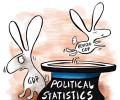
There has been criticism of the official statistics ever since MoSPI came out with new methodology to estimate the GDP on the base year of 2011-12 compared to earlier 2004-05.

From a national point of view, inflation is the biggest threat posed by finance ministers.

'If because of El Nino, the monsoon is affected adversely in the current year, naturally it will affect income projections and consequently Budget numbers.'
Going by its past experience of differences between the central bank and the finance ministry, the government might prefer a person who could bridge this gap.
Rajan will evolve a policy with the help of professional persons for a national consensus if we have to carry on with implementing social and economic changes in a complex economy.

'The actions of Indian monetary authorities will depend on how quickly they want the inflation to come down to 4 per cent.'
.jpg)
Raghuram Rajan, who took over as RBI Governor on September 4, is scheduled to unveil on Friday mid-quarter monetary policy review, an event keenly awaited by industry and banks.

Sajjid Chenoy, India economist at JP Morgan is the new part-time member.

Says licensing of new banks should be a continuous process instead of the current stop-go system

'...Unless we muck up our policies.' 'We have to become a modernised economy.' 'Our institutions should be stronger. And that is most important.' 'The rule of law should prevail and contracts should be enforced.' 'Above all, we have to recognise the importance of globalisation.' 'It is in our favour at this stage. We should grow and become globally competitive.'

Prime Minister's Economic Advisory Council (PMEAC) Chairman C Rangarajan may have found the Reserve Bank of India (RBI)'s inflation projections on the higher side, but independent experts agree with the central bank and expect both wholesale and retail prices to remain high.

The size of the hole in today's banking crisis appears to be roughly 10 per cent of GDP.

Issuance of new bank licences proves that the apex bank wants the financial sector to flourish.

This is because the bond market has factored in the Rs 4.88-trillion gross borrowing for April-September 2020.
Experts disagree with the idea and the Reserve Bank of India (RBI), which has the sole right to print money, is not comfortable with it as well.
The mood at the Indian Institute of Management, Ahmedabad (IIM-A) is festive, with one of its alumnii, Raghuram Rajan taking over as the next Reserve Bank of India (RBI) governor.

His finest years came when he served as deputy governor under C Rangarajan.
Rajan's exit will neither affect the RBI's de facto independence nor its working.
'From where prime ministers sit, it makes no difference at all who occupies the governor's post.' 'Literally anyone with a decent education or work experience can be appointed to the job, which is basically a managerial one with little room for manoeuvre,' says T C A Srinivasa-Raghavan.

The World Bank said improved infrastructure, specifically rural electrification, has had far-ranging effects

'The real lifting of the economy will happen only if this momentum sustains in the coming months.'

The RBI governor has to convert the zero-sum game with the government from a non-cooperative one -- which his two predecessors had made it -- to a cooperative one, explains T C A Srinivasa Raghavan.
.jpg)
The stock market responded to his speech by going up by over two per cent; the rupee also gained in strength, by about 1.45 per cent, against the dollar.
Rajan, as expected, furthered his predecessors' agenda and continued with the same resolution to make India's financial system safer, and direct the economy towards further liberalisation
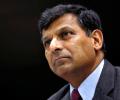
Rajan tells RBI colleagues he will be returning to academics

Are we adopting an idea whose time has come and gone? My feeling is, yes, says ex-banker C Joseph Chacko in the fourth article of the series on inflation targeting.

In putting the country's economy back on the rails, it is best that Narendra Modi and Arun Jaitley draw on grass-roots feedback and their own practical sense and native wisdom without allowing themselves to be sucked into the quicksand of economic punditry, says B S Raghavan.
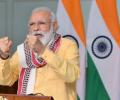
Aakar Patel looks forward to Prime Minister Modi's speech at the bhoomi pujan for the Ram temple in Ayodhya next week. It will be entertaining and stirring, predicts Aakar, and make lots of promises that he most likely won't be able to keep.

This has spelt trouble for the mills. Most of them are unable to pay the farmers.

The demand was raised during a debate on the Constitution (123rd Amendment) Bill 2017 in the Upper House, which was passed by the Lok Sabha on August 2 superseding the amendments earlier carried out by the Rajya Sabha.
 © 2026 Rediff.com - Investor Information - Advertise with us - Disclaimer - Privacy Policy - Sitemap - Feedback - About us - Terms of use - Grievances